Interactable Volleyball Rotation
Understanding volleyball rotation can be one of the most confusing aspects for new players and coaches. This interactive guide breaks down the rotation system, positions, and movement patterns that form the foundation of competitive volleyball.
The Basics of Rotation
In volleyball, all six players must rotate positions clockwise each time their team wins the serve from the opponent. This ensures every player gets a chance to play in each position, though specialized roles emerge once the ball is served.
The Six Positions
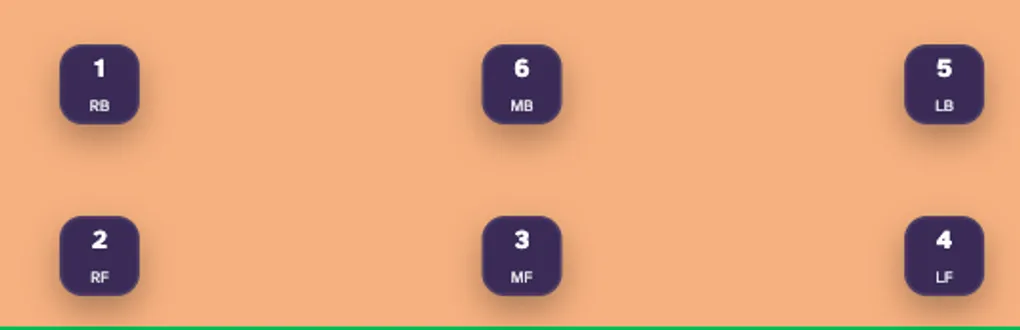
The court positions are numbered 1 through 6:
- Position 1: Back right (Server position)
- Position 2: Front right
- Position 3: Front middle
- Position 4: Front left
- Position 5: Back left
- Position 6: Back middle
Rotation Rules
Key Points to Remember:
- Rotation occurs only when your team wins a rally while the other team was serving (called a “side out”)
- Players rotate clockwise - Position 1 moves to 6, Position 6 to 5, and so on
- The player in Position 1 always serves
- Before the serve, players must be in their rotational positions
- After the serve, players can move to their specialized positions
Interactive Rotation Demo
Try dragging the players around to see how volleyball rotation rules work. The demo enforces legal positioning requirements - players must maintain proper alignment with their teammates.
- Row rule: In the front row, LF must be left of MF, MF must be left of RF. In the back row, LB must be left of MB, MB must be left of RB.
- Column rule: Each back row player (LB, MB, RB) must be behind their front row partner (LF, MF, RF).
Common Formations and play styles.
“No Setter” / Free Play (Simplest)
- Everyone just plays the ball back over without worrying about designated positions.
- Used in very young ages (2nd–4th grade) to keep it fun and reduce confusion.
- No rotation rules taught yet, just “next server rotates.”
- Whack-it-back
Advantages:
- Super simple — no role confusion, everyone just focuses on contacting the ball
- Fun and fast — keeps rallies going without kids worrying about rotations or positions
- Encourages participation — nobody feels pressure to “be the setter” or know advanced rules
- Great for K–3 or brand-new players learning platform, serving, and basic court awareness Challenges:
- No real offensive system — mostly sending the ball over, not structured attacks
- Doesn’t prepare kids for higher-level volleyball where systems matter
- Harder to teach spacing/overlap rules later if kids don’t practice positions early
- Some players might dominate touches while others don’t learn responsibility
6–6 (Everyone Sets)
- Every player rotates through all six positions.
- Whoever is in the front right (Position 2) becomes the setter for that rotation.
- Everyone gets a chance to set, hit, pass, serve.
- This is often the first “real” system taught because it’s fair and simple.
Advantages:
- Fairness — every player gets a chance to set, hit, pass, serve
- Builds all-around skills — kids don’t get “stuck” in one role too early
- Easy system to explain — “whoever is in right front is the setter”
- Two or three front-row attackers always available
- Natural bridge between “no setter” and more structured systems like 4–2 Challenges:
- Inconsistent setting — some players will be much weaker setters, which limits offense
- Confusion at first — kids forget who should be setting each rally
- Slower transitions — players may hesitate because they’re unsure if they should set or hit
- Not game-like for advanced play — doesn’t mirror what they’ll see in middle/high school competition
4-2 System
Two setters who set from the front row. Common in beginner volleyball and the simplest system to learn.
Advantages:
- Simple to understand
- Easy rotation patterns
- Good for learning basic volleyball concepts
Challenges:
- Only two front-row attackers
- Limited offensive options
5-1 System
One setter who sets from all six rotations. This is the most common system in competitive volleyball.
Advantages:
- Consistent setting from one player
- More attacking options with three front-row hitters
- Most versatile system
Challenges:
- Complex rotation patterns
- Setter must be athletic and versatile
- Requires advanced understanding of positioning
6-2 System
Two setters who only set from the back row, allowing for three front-row attackers at all times. The most complex system.
Advantages:
- Always three front-row attackers
- Maximum offensive firepower
Challenges:
- Two different setters means less consistency
- Requires two skilled setters
- Most complex rotation patterns
Specialized Positions
Once the serve is contacted, players move to their specialized positions:
Outside Hitter (OH)
- Plays front left when in the front row
- Primary attacker and passer
- Usually receives most sets
Middle Blocker (MB)
- Plays middle positions
- Key blocker and quick attacker
- Often substituted by libero in back row
Opposite/Right Side (OPP)
- Plays opposite the setter
- Strong attacker and blocker
- Often the go-to hitter in critical situations
Setter (S)
- Runs the offense
- Touches the ball on every possession
- Must have excellent court awareness
Libero (L)
- Defensive specialist
- Cannot attack or block
- Wears different colored jersey
- Can substitute freely for back-row players
Rotation Strategies
Serve Receive Formations
W-Formation: Five players form a W shape to receive serve, with the setter hidden or protected.
U-Formation: Three players form a U shape, common when you have strong passers.
Offensive Transitions
After the serve, watch how quickly players transition:
- Middles sprint to the center
- Outside hitters move to the left
- Setter releases to their setting position
- Back row players adjust for coverage
Common Rotation Errors
- Overlapping: Being out of rotation order before the serve
- Wrong Server: Player from wrong position attempting to serve
- Illegal Substitution: Not following substitution rules
- Back Row Attack: Back row player attacking from in front of the 3-meter line
Tips for Learning Rotation
- Start Simple: Learn the 4-2 system first
- Use Visual Aids: Draw rotations on paper or whiteboard
- Practice Transitions: Focus on moving from rotational to playing positions
- Watch Games: Observe how professional teams handle rotations
- Communicate: Call out rotations and positions during practice